
LOCAL: Alberta city approves $33 million solar farm

Source

St. Albert says the 55-acre, 15-megawatt solar array could power 25,000 homes and generate $2.4 million for the city each year

St. Albert, Alberta, will be host to a 15-megawatt solar farm in just two years, city council has decided — one that will power 25,000 homes and generate some $2.42 million a year.

St. Albert council voted 6-1 June 21 to approve the project charter for the $26.1-million solar farm that would be built on 55 acres of city-owned land, known as the Badger Lands.

Council also voted 6-1 on first reading of a bylaw to borrow up to $33.7 million to fund the project (the estimated cost plus 25-per-cent contingency).

Sheena Hughes was the only council member opposed to both motions.

City administration hired the energy firm ATCO to craft plans for the farm. ATCO’s design would see approximately 34,350 rack-mounted, double-sided solar modules, and recommended the city build it all in one go.

“You want to install the biggest solar farm you can afford to achieve economies of scale,” explained ATCO engineer Rachel Si.

Si told council the Badger Lands were a good site for a solar farm as they are flat, accessible, city-owned, salt-contaminated (meaning they would require expensive cleanup for most other uses), and close to an electrical substation.

ATCO officials told council the farm would produce about 21,800 megawatt-hours of electricity a year — enough to power some 25,000 homes, or 96 per cent of the homes in St. Albert, which is located close to Edmonton in north central Alberta.

Studies suggest this would prevent some 15,449 tonnes of greenhouse-gas emissions a year — equivalent to not burning 205 tanker trucks’ worth of gasoline.

Council heard the farm would cost about $110,000 a year to run. Power sales, carbon credits, and other revenue sources would result in net annual revenues of about $2.42 million a year, or $41 million over the 30-year life of the farm. The array would pay for itself in 12.8 years, provide stable electricity costs, and reduce the city’s carbon emissions. These predictions did not account for potential grants.

City environmental manager Christian Benson said solar has been a proven technology since the 1970s and is easy to use and maintain. Alberta has about 35 large solar farms in operation and in production, including projects in Innisfail and Fort Chipewyan.

“The economics are solid,” Benson said, with solar farms drawing considerable foreign investment to Canada.

Hughes criticized ATCO’s projections as overly optimistic, as they assumed Canada’s carbon tax and energy prices would ramp up considerably in the coming decades.

“I’m not going to assume [Prime Minister] Trudeau is going to raise the carbon tax to $170 a tonne over time as a business model,” she said. (The federal government has said the tax would reach that level in 2030.)

Hughes said this project would merely break even if carbon taxes and energy prices stayed flat, which she argued was not worth a potential $33-million investment.

The borrowing bylaw was scheduled to return to council August 30. If approved, the farm would start construction in July 2022 and be operational by April 2023.


LOCAL: Edmonton a renter’s paradise

Source

Rents are low, wages are high and investors are buying apartment buildings for around $120,000 per door

Edmonton, Alberta’s capital where the average annual income is almost $10,00 higher than Vancouver, has become a paradise for renters, with some of the lowest rents in the country.

A national survey, released June 16, found that while rents across Canada had increased 2 per cent in May from a month earlier to an average of $1,708 per month, tenants were still paying less than $1,000 for a one-bedroom in Edmonton.

Edmonton finished 30th on the list of 35 cities for average monthly rent in May for a one-bedroom home at $992 and for a two-bedroom at $1,215, according to the National Rent Report from Rentals.ca and Bullpen Research & Consulting.

“Average rents in Edmonton for a one- and two-bedroom home in May saw little change monthly or annually, “ the report found.

In comparison, Vancouver leads Canadian cities for average monthly rent, with a one-bedroom rent in May at $1,981 and for a two-bedroom at $2,760, the National Rent Report found.

Calgary finished 27th on the list of 35 cities for average monthly rent in May for a one-bedroom home at $1,216 and for a two-bedroom at $1,530.

Edmonton also has plenty of rentals to choose from, with an 8 per cent vacancy rate, and more than 6,808 new rental units built or nearing completion in the city, according to commercial real estate agency CBRE.

The big supply and low rental prices are reflected in prices and demand for existing apartment buildings.

The second half of 2020 saw $121 million in multi-family investment in Edmonton, down significantly from the $367 million in the first half of the year, with just 21 buildings sold.

The largest multi-family transaction in the second half of 2020 was Westlawn Village transacting 144 units at an average price of $155,903 per unit.

This June 15, a two-building rental complex in Edmonton with a total of 58 units sold for $6.8 million, or less than $118,000 per door, based on the transaction brokered by the Marcus & Millichap team in Edmonton.

Capitalization rates for the 12 low-rise Edmonton apartment buildings sold so far in 2021 averaged 4.92 per cent, according to a survey by the Network and released to Western Investor by Avison Young. The median per-door price for the buildings was $113,440. Mid-rise concrete apartment buildings in Edmonton generally sell at lower cap rates, in the sub-4 per cent range, Avison Young noted.

Edmonton, as in all of Alberta, has no rent controls. This compares with B.C., which has among the most rigid rent legislation in Canada.

Higher average incomes in Edmonton are also substantially higher than the national average, and well ahead of Vancouver.

In March 2021, average weekly earnings in Alberta remained the highest in Canada at $1,226, an increase of 3.1 per cent from March 2020. Nationally, average weekly earnings were $1,132 in March 2021, according to Statistics Canada.

The average salary in Edmonton in the first quarter of 2021 was $97,220, compared to a national average of $89,596 and an average of $88,223 in Vancouver, based on a study from the Average Salary Survey, an international research study based in the U.K, released this June.

‘Canada’s smallest house’ is priced under $25,000

Source

The locally built, 72-square-foot Yocto comes with full appliances and doesn’t require a building permit

In Greater Vancouver, where the average detached house sold for $1.8 million in May and a typical condo apartment for $737,000, a small-house builder is offering perhaps the least expensive—and smallest—house in Canada.

“Our core business is for granny flats and homes for First Nations,” said Chase Lefneski, a spokesman for Dwelltech, based in Maple Ridge, B.C., where the May benchmark house price was up 34 per cent from a year ago to $1.1 million.

Dwelltech makes three different small houses.

Its latest offering, the Yocto, is the tiniest—72 square feet.

“We think it is the smallest complete house in Canada,” Lefneski said.

Despite its compact space, the Yocto comes with full-sized appliances, a closet and a built-in bed and mattress.

“The bathroom works perfectly. It’s a residential toilet and shower, not a small RV-type fixtures,” Lefneski said. “It’s a little hard to believe all that fits in 72 square feet.”

The houses come with a 20-year warranty on roof, walls, doors and windows.

“It is built like a tank. They are made for rough use and to be easily moved as many times as you want,” according to Lefneski.

The small houses sell for $24,900, he noted, and do not require a building permit.

The tiny homes do need water and power access and hookup to a septic or municipal sewer system.

The Yocto may provide another option for municipalities and community groups trying to house the most vulnerable residents.

In Victoria, a tiny-house village, which converted standard 20-foot shipping containers into 160-square foot homes, opened May 12 as temporary homes for Victoria’s homeless population.

The 30-unit project, by Aryze Developments, was partly financed by $550,000 raised during a three-month crowdfunding campaign.

The little houses come equipped a bed, side table, a small fridge and armoire, but village residents share communal bathrooms.

In Alberta, the Homes for Heroes Foundation has opened a small-home project meant to house homeless veterans who served in Canada’s armed services.

Some of the 300-square-foot homes, designed with the help of trailer manufacturer Atco Structures, were set up in a 2020 Calgary project.

A second village is being finished in Edmonton. Scheduled to open this fall, the Edmonton village consists of 18 small homes, two accessible homes, an office and an amenity building.

Is Your A/C Summer-Ready? 12 Things to Check Before the First Heat Wave

Source

Make sure your A/C can handle any heat wave this summer with these tips and how to know when to call in the pros.

Soaking in the summer sun is part of the fun of the season. But if you don’t have a cool home to retreat to, that heat can start to feel overbearing. Make sure your A/C (or swamp cooler!) can handle any heat wave this summer with these 12 tips, plus guidance on how to know when to call in the pros.

Before beginning preparation steps for either an air conditioner or swamp cooler, make sure the unit is turned off and disconnected from power.

Prepping Your Air Conditioner
1. Clean the filters
Remove the filter from the unit and vacuum away dust and buildup. If there’s more buildup than your vacuum can handle, you can wash the filter in the sink or with a hose. If the filters are very dirty, or it’s been longer than three months, you’ll need to replace them.

2. Clean condensate lines
The condensate lines draw water from the evaporator coils and run it into the drain pan. You can make sure these lines are clog-free using a vacuum to suck out any debris and then pour a mixture of vinegar and water through the lines.

3. Check coolant lines
Examine the lines that carry the refrigerant to ensure there aren’t any signs of leaks. If you do see signs of leaking, you may want to call an HVAC professional to repair the unit.

4. Remove debris from around condenser unit
Sweep away any leaves and debris from around the condenser unit and vacuum or hose debris from the walls of the unit itself. This allows your A/C to efficiently release the heat that it draws out of your home.

5. Check the ductwork
Ducts don’t often need cleaning, but it’s important to take care of the situation quickly when they do. If you see pet hair emerging from your ducts or notice a foul smell coming from any of them, it’s time to call in an HVAC professional.

6. Clean supply and return vents
Ensure your A/C can efficiently pump cold air into your home and pull hot air out by cleaning the supply and return vents inside the house.

7. Test the unit
Do a test run of the unit on a warm day to determine if air is blowing from all of the vents and the house is cooling adequately.

If after that first-day test run, your A/C is not adequately cooling your home, or it’s turning off when it shouldn’t or making loud noises, it’s time to call in the pros. Keep in mind that an A/C unit lifespan is only around ten years. After this age, you may want to consider replacing the unit. You’ll almost certainly see some savings on your electricity bill with a more efficient model, and you’ll stay cooler through the hot days of summer.

Prepping Your Swamp Cooler (Evaporative Cooler)
Preparing your swamp cooler for summer involves similar steps to preparing an air conditioner.

1. Clean the exterior
Remove the cover or clear any debris from the swamp cooler and wipe down the outside of the unit to remove any dust.

2. Clean the interior
Open the sides of the cooler and vacuum out any debris. Wipe down the sides and base of the interior.

3. Replace pads
Especially if they’ve hardened, it’s essential to change the pads that absorb water within the cooler. It’s advisable to replace these at least every year.

4. Connect the water line
Reconnect the water line to the unit and check the pipes to ensure they’re in good condition.

5. Test the unit
Turn on your swamp cooler and verify that the pump and blower are working and that you don’t see any leaks.

If your swamp cooler isn’t blowing cold air, isn’t wetting the pads, or is making strange noises, it’s time to call in the pros. The lifespan of a swamp cooler is also around ten years, so if yours is older than that, it might be time to consider a replacement.

A broken or under-functioning air conditioner or swamp cooler can make summer miserable. Make sure yours is ready to help you beat the heat of the season!

LOCAL: City gives $5M clean energy improvement program green light

Source

Homeowners would be able to make energy-efficiency upgrades to their homes for no money down, with the cost of those upgrades repaid over decades through property taxes.

St. Albert residents will be able to put up solar panels and new insulation next year for no money down under a new $5-million program approved by city council.

St. Albert council voted unanimously May 17 to approve third reading of the Clean Energy Improvement Tax bylaw.

The law lets the city borrow up to $5 million over four years to fund a Clean Energy Improvement Program (CEIP). Under it, St. Albert homeowners will be able to have certified contractors install certain energy-efficiency upgrades to their homes for no money down, with the cost of those upgrades repaid over decades through property taxes.

St. Albert environment manager Christian Benson said in an interview this program would help residents save energy and add value to their homes while also reducing the city’s contributions to global heating.

“I’m really excited as a resident for CEIP,” Benson said.

Green potential
CEIP is known as Property Assessed Clean Energy (PACE) outside of Alberta, and is seen by many economists as a way to encourage energy-efficiency upgrades to buildings that otherwise would not happen due to their high up-front cost. It also hooks the bill for those upgrades to the building, not the building’s owner, so the owner can sell the place before paying off the upgrade without fear of “losing” their investment.

The U.S. has done some $6.4 billion in upgrades through PACE in the last five years, Leigh Bond of the advocacy group PACE Alberta told council.

A January 2021 market study by the Municipal Climate Change Action Centre found a St. Albert PACE program would likely draw about 254 applicants over four years who would make some $5 million in home improvements. This would save the city $4.1 million, add $17 million to its economy and prevent about 30,700 tonnes of greenhouse-gas emissions over the life of the improvements – equivalent to taking about 6,700 cars off the road for a year, the U.S. Environmental Protection Agency reports.

Steven Ottoni, who oversees Alberta’s CEIP/PACE programs through the Alberta Municipal Services Corporation, told council St. Albert’s program would let homeowners make up to $50,000 in approved improvements (which typically include solar panels, heating systems, and insulation) to their homes for no money down. Owners would do a home-energy evaluation to figure out which upgrades have the best paybacks, then have an approved contractor do them. The city would pay the contractor and place a special tax on the property to recover that cash over about 25 years.

Benson told council the city plans to borrow the $5 million from the Federation of Canadian Municipalities to fund PACE, and to apply for a $2.45-million grant to offset the program’s administrative costs. Council could also enhance PACE with the proposed Home Energy Retrofit Accelerator program, which is now under development.

Bond said St. Albert should start with a commercial PACE program instead of a residential one. Commercial owners require less administrative support, as they have their own engineers, and commercial buildings tend to be energy hogs with more opportunities for cheap savings.

“(Commercial) PACE programs cost way, way less to administer and have a bigger impact,” he said.

City utilities and environment director Kate Polkovsky said the city wanted to practice with a smaller-scale residential PACE program before rolling out a bigger commercial one.

Bond also said the city had vastly underestimated demand for PACE – he estimated there is demand for about $154 million in upgrades in town between now and 2030 – and should up the size of its program to $50 million.

Ottoni said demand for PACE in Alberta is unclear, as it is a new idea here, and said his group had settled on $5 million based on the experience of other communities.

“We do think there is pent-up demand,” he said of energy efficiency, and $5 million could be an under-estimate.

In an interview, Benson said staff would work out the details of St. Albert’s CEIP/PACE program and hope to launch it next year.

Cabin & Cottage Trends Across Canada (2021)

Source

Canadians opt for more affordability and new lifestyle, flocking to recreational property market
57 per cent of markets offer properties below $500K, according to RE/MAX brokers and agents

-Average sale price anticipated to rise up to 30% in some recreational property markets, according to RE/MAX brokers and agents.
-44 per cent of recreational property buyers are budgeting $200,000-$500,000 in the next 12 months.
-57 per cent of Canadian recreational markets include at least one property type within the $200K-$500K price range.

Kelowna, BC and Toronto, ON, May 18, 2021 – The red-hot demand seen in Canada’s urban centres has migrated into recreational markets, as interest and activity in suburban and rural properties continues to grow. Despite rising demand, 57 per cent of Canadian recreational markets still have at least one property type with an average price below $500,000, according to the 2021 RE/MAX Recreational Property Report. Furthermore, 57 per cent of RE/MAX brokers and agents in recreational markets anticipate single-digit price growth over the remainder of 2021.

According to a Leger survey conducted on behalf of RE/MAX, more than half of those who plan to purchase a recreational property in the next year (59 per cent) are first-time recreational property buyers. Twenty-one per cent of Canadians are looking to recreational markets after being priced out of an urban centre. Low borrowing rates are working in their favour, with 22 per cent saying the lower rates have increased their ability to buy.

The survey also found that 11 per cent of Canadians were searching for a recreational property prior to the start of the pandemic and are still searching, and 15 per cent of Canadians who were not searching for a recreational property prior to the pandemic are now looking.

Shifting home-buying trends, as prompted by the pandemic, are exacerbating inventory challenges in a majority of recreational markets across Canada. The growing demand in these regions is also putting upward pressure on prices which is impacting affordability in many recreational markets, which RE/MAX brokers anticipate will be a long-term trend. Tofino, Ucluelet and Niagara regions, to name but a few, are experiencing low inventory levels, bidding wars and sky-high prices.

“There’s intense competition among buyers in Canada’s recreational property markets and inventory is stretched thin,” says Christopher Alexander, Chief Strategy Officer and Executive Vice President, RE/MAX of Ontario-Atlantic Canada. “But Canadians recognize that recreational properties remain an affordable option in such a turbulent market. There are still many recreational markets across Canada that are deemed affordable, despite the growing demand and rising prices.”

Affordability Outlook
According to RE/MAX brokers and agents, sellers’ market-like conditions are anticipated to persist for the remainder of the year in 97 per cent of regions examined in the report. These conditions are typically accompanied by rising prices, which has been a trend in 2020 that is expected to continue through 2021. RE/MAX brokers report that 57 per cent of Canada’s recreational markets include at least one property type priced in the $200,000 – <$500,000 range. This is down from 87 per cent in 2019.

The most affordable recreational regions for waterfront properties across Canada include Thunder Bay ($425,805), Charlottetown ($334,447) and the Interlake Region of Manitoba ($363,833), while Okanagan ($2,430,434), Barrie-Innisfil ($1,841,217) and Niagara region ($1,546,561) are the most expensive recreational property markets for waterfront properties.

Regional Market Highlights
Western Canada
A majority of Western Canada’s recreational markets are sellers’ markets, including Whistler, Shuswap, Canmore, Tofino, Ucluelet, Central Okanagan and Interlake Region of Manitoba. Most regions are seeing multiple offer scenarios, driving prices up for most property types. Out-of-province buyers – typically from Ontario – are looking to Canmore in pursuit of recreation and achieve greater work-life balance. With work-from-home conditions, demand has spiked and prices of non-waterfront properties in Canmore have increased by 26 per cent since 2019. Out-of-province buyers from the Lower Mainland and Vancouver Island are eyeing Tofino and Ucluelet, as well as out-of-country buyers from California. Both are looking to the region for the desire to relocate from urban centres and for a secondary residence.

With low inventory in Manitoba’s Interlake Region, prices of waterfront properties have increased by 43 per cent since 2019. Most activity is driven by buyers from within the province, typically families, millennial couples or investors looking for an affordable option outside of urban centres. With most buyers working from home in the region, good Wi-Fi access has become a top priority.

About the 2021 RE/MAX Recreational Property Report
The 2021 RE/MAX Recreational Property Report includes data and insights from RE/MAX brokerages. RE/MAX brokers and agents are surveyed on market activity and local developments. Average sale price prediction range is reflective of all property types in a region and varies depending on the region. Regional summaries with additional broker insights can be found at RE/MAX.ca.

READ THE WHOLE REPORT HERE   

Mortgage stress test gets more stressful on June 1

Source

Some may try to buy a home before the deadline.

As of June 1, 2021, homebuyers applying for an uninsured mortgage—those with more than a 20 per cent down payment—will need to qualify as if their mortgage rate was 5.25 per cent, or two per cent higher than their actual contract rate, whichever is higher.

In reality, Canadians can access five-year variable rate mortgages as low as 1.24 per cent at HSBC Bank Canada and 1.4 per cent at the Royal Bank of Canada, the largest mortgage insurer in the country, according to April 30 data from RateSpy.

Currently, Canada’s mortgage stress test has a minimum qualifying rate of 4.79 per cent—nearly 50 basis points lower than it will be affective June 1.

The Office of the Superintendent of Financial Institutions (OSFI) superintendent Jeremy Rudin has said that the change was necessary to ready the market for the end of the pandemic.

“The main thing we have to be ready for is an increase in mortgage rates to the pre-pandemic range,” Rudin told reporters on April 8. “We have interest rates that are extraordinarily low, even by recent standards.”

He warned lenders “OSFI will be looking for heightened vigilance in applying to income verification and debt servicing, combined mortgage-HELOC loan plans and risk governance.”

The OFSI rules apply to federally-regulated lenders.

In other words, mortgage qualifications could get much harder for those with high home equity loans, disruptive income and related debt. Due to COVID-19, many Canadians may fail to meet the tougher standards.

“Increasing the qualifying rate by another almost 50 basis points will only serve to disqualify more aspiring middle-class Canadians and would-be first-time buyers,” Paul Taylor, president and CEO of Mortgage Professionals Canada told Canadian Mortgage Trends.

It’s estimated that this change would reduce purchasing power for uninsured borrowers by between 4 per cent and 4.5 per cent. This is enough, according to real estate agents, for some buyers to close deals before the June 1 deadline.

BC Step Code will nail up to $48,000 onto new house cost

Source

BC Energy Step Code will prove costly as it ascends to new homes that, ideally, generate more energy than they use, builders warn

In December 2017 the B.C. government introduced the ambitious BC Energy Step Code, a building code with five steps towards creating ‘net-zero’ energy-use homes by 2032.

It is the toughest code in Canada and a testing ground for the new national building code, now in the works, that will also put an emphasis on climate change. An objective of the code is to also reduce greenhouse gas emissions, since buildings account for about 30 per cent of such emissions, according to government reports.

It will also add tens of thousands of dollars to new homes built to the highest level of the new code, which comes into effect this summer in all North Shore municipalities.

The Step Code is not yet mandatory and gives B.C. municipalities the option to have residential construction meet one or more steps of the Step Code as an upgrade to the existing code. (The City of Vancouver has its own building code and is moving towards having all new homes becoming net zero by 2030).

Step 1 is a minor improvement over the existing code, while the second step is a 10 per cent improvement in efficiency. Step 3, which nine Metro Vancouver municipalities have already moved to, along with some of the larger centres in the Greater Victoria region, specifies a 20 per cent improvement. Step 4 is a 40 per cent upgrade from current standards.

Step 5 requires builders to construct homes that be net-zero, meaning the home produces more energy than it uses.

“It is a function of the efficiency of the HVAC [heating, ventilation and air conditioning] equipment, the tightness of the envelope, the degree of insulation, all these different things,” explains Ron Rapp, CEO of the Homebuilders Association of Vancouver (HAVAN).

A certified energy adviser must sign off on plans that meet performance models; then the final structure is checked with a blower door test, which uses a specialized fan to measure how tightly a building is sealed against air leakage.

A typical older house, due to natural leakage, may have 10 to 20 air changes per day. A Step 5 level house would have less than one air change daily.

The City of West Vancouver, the District of North Vancouver and the City of North Vancouver will all require Step 5 – which has the highest air tightness – as of July 1, 2021, the first municipalities in Canada to do so.

Home builders are now finding just how steeply expensive stepping up can become.

A 2019 HAVAN modelling study of a standard new detached house estimated that the cost to implement Step 1 would be $5,600 above the current building code. To meet Step 3 would add $15,300 and that cost would rise to more than $24,000 at the Step 4 level.

At Step 5, primarily because of the much higher levels of insulation, advanced mechanical systems and ultra-high-performance windows, the cost soars to $48,220 for a typical house.

“It would be much more than that on a large custom-built house: at least $70,000 to $110,000,” said Casey Edge, executive director of the Victoria Residential Builders Association and a consistent critic of the Step Code.

Edge noted the costs are layered onto new homes, while the much larger pool of existing homes, many built decades ago, continue to emit most of the emissions.

Larry Clay, founder and president of Clay Construction Inc. in Langley and incoming national president of the Canadian Home Builders’ Association, sits on the industry’s National Net Zero Committee, which works with the federal government on building code standards.

His company builds eight to 10 houses per year valued at up to $3 million, all of them to Step 3 and up to net-zero standards.

Clay said it was fairly easy for B.C. builders to achieve Step 2 and even Step 3, but the challenges increase at higher levels, and it is not only about cost.

He cites the example of a large custom house he is building in Langley under a Step 3 building code. The client had considered going to Step 5 – net zero – until energy modelling showed the design changes that would be needed. These included much thicker walls, much smaller windows and changes to roof overhangs.

The client said “no way” and kept with the original design.

“At what point,” Clay asks, “does a homeowner have the right to keep the design they want?”

He said window size and orientation could become a big issue under Step 4 or 5. For example, he notes, in Burnaby and Vancouver many homeowners may want a big-window north view of the Inlet and the mountains, but the Step Code would require small or no north-facing windows, without substantial costs added.

Clay said adding $25,000 to $50,000 onto the price of a new house may fly in Canada’s most expensive markets of Vancouver, Victoria or Toronto, but not in most of B.C. or Canada.

Builders in many smaller centres try to deliver new houses that cost around $300,000, he notes.

“Adding $24,000 to $50,000 to the cost would kill their business,” Clay said.

Clay – who is also the immediate past-president of HAVAN – and Edge both say the fact that different municipalities have conflicting Step Code requirements adds to the cost and confusion for builders and consumers.

“Municipalities are circumventing the purpose of the Step Code, which was to slowly improve the code to let builders and suppliers become familiar with it,” Clay said.

Clay, who becomes president of the Canadian Home Builders’ Association this May, notes that Canada’s new national building code, expected to be introduced in 2025, will also require much higher levels of energy efficiency and other measures to combat climate change.

Clay said home builders are as concerned about the environment as anyone and will meet any standards demanded, but that government incentives, perhaps mortgage industry price breaks, may be needed.

“We will get there [to net zero]. We have to, but we need help,” Clay said. “Home builders can’t do it alone.”

Can REALTORS®—or Clients—Secretly Record Potential Buyers?

Source

Smile! You’re being secretly recorded.

Oh, the joys of privacy law! With more twists and turns than an Agatha Christie novel, it truly is the gift that keeps on giving… if you’re a privacy lawyer. For normal people, maybe not so much.

Perhaps it’s because of the warmer weather that’s just around the corner (don’t burst my bubble), but a privacy topic I’ve been frequently asked recently is whether there are any privacy issues with REALTORS®, or their clients, secretly recording potential purchasers visiting a property for sale. The rationale for doing so being that a recording can help protect the seller’s property.

This question can be approached from a legal point of view and from a philosophical point of view.

Law and philosophy in one blog post, you say? Tell me more!

Well, the legal point of view is that, yes, secretly recording potential buyers visiting a property without the buyers’ consent constitutes the unauthorized collection of the buyers’ personal information and raises the risk a privacy complaint could be made against the seller and/or the listing agent under the Personal Information Protection and Electronic Documents Act (PIPEDA) or provincial privacy legislation.

Further, if the recording captures a private communication (for example, between a buyer and his/her agent) it could constitute a criminal offence under section 184 of the Criminal Code(interception of communications).

If sellers and/or their listing agents wish to make a recording (regardless of whether it’s an audio or video recording) of buyers, they should get the buyers’ consent. The most effective way to do this to is to get the consent in writing (for example, via an email acknowledgment). An alternative, albeit riskier, method is to post a prominent notice on the property telling buyers they are being recorded prior to them entering the premises. Buyers who choose to enter the property after reading the notice implicitly provide their consent to be recorded.

Still not convinced? Let’s try the philosophical approach by conducting a thought experiment.

Whenever I consider whether it’s appropriate to collect someone else’s personal information, instead of just focusing on what I want to do, I find it helpful to put myself in the shoes of the person whose personal information I am collecting (in this case, via a recording).

Would I object if I was recorded without my knowledge? What if my conversation with my spouse or agent was recorded? What if what I say is used against me in my negotiations with the seller?

Hmmmm… you can see how something that may seem relatively innocuous from one perspective (a homeowner trying to take safety precautions, for example) can start to look mighty shifty from another perspective.

And that brings us back to the legal answer. It may prompt an awkward conversation, but in this case, it goes a long way.

The article above is for information purposes and is not legal advice or a substitute for legal counsel.

What’s Trending in 2021: Home Paint Colors

Source

Tackling a home decorating project in 2021? These are the hottest paint colors this year.

Celebrate the spring of 2021 by giving your home interior a refreshing colour update. Nothing says new year, new you like a splash of colour on an accent wall. Or maybe you’re looking at warm, earthy neutrals throughout to bring grounding to your life and space. Whatever your reasons, whatever the room to redecorate, this year’s colour trends are ready to help you say goodbye to 2020 and embrace a hopeful and happy year ahead.

Take a look at this list of the hottest home paint colours of 2021 according to trusted home-style guides like Better Homes & Gardens and Good Housekeeping and the official Colours of the Year by paint colour kings like Behr and Benjamin Moore:

Walls
It’s unanimous–2021 is about warmer whites and grounding, earth-tone neutrals contrasted with bold, dare we say audacious, hues. Which do you feel best represents and inspires you in your space? We’ve highlighted this year’s colours of the year by category below, neutral and vibrant.

If you’re looking for a calm, inviting base to use absolutely anywhere, check out these trending neutrals:

Ultimate Gray
Named one of the two colours of the year, Pantone calls Ultimate Gray a “dependable” colour. And certainly, this versatile colour works in any home setting, especially in rooms where you want to evoke a sense of strength and solidity. (Pantone’s second colour of 2021 was “Illuminating,” a warm, happy yellow that pairs nicely with Ultimate.)

Urbane Bronze
Sherwin-Williams chose this nature-inspired colour as their 2021 colour of the year. Its deep bronze warmth creates a soothing, earthy backdrop designed to bring you back to nature and highlight other organic elements in your interior design.

If big colour is what you’re after, check out these vibrant hues:

Aegean Teal
This blue-green paint, named colour of the year by Benjamin Moore, is calm but bold. Both its name and its hue bring to mind the waters and the spirit of the Mediterranean.

Passionate
As part of HGTV Home by Sherwin-Williams’s “Delightfully Daring” colour collection, Passionate plays its part in bringing boldness to your space. This rich, warm red is perfect for those spaces where you want to bring your passion.

Behr’s Color Trend Palette
This is a selection of 21 colours, including earthy and comforting browns and yellows accented with adventurous colours like “Euphoric Magenta” and “Saffron Strands.” Keywords to convey the spirit of this collection include “warm,” “restorative,” and “evocative.” So whatever balance you want your 2021 to strike, they’ve got a colour to help you achieve it.

Accent Walls & Accessories (furniture and more)
As you know, paint isn’t only for walls. Refinishing a dresser or table with a bright coat of paint can create an inspiring statement piece and quickly rejuvenate a stale or tired atmosphere. Try these trending colours to bring some spice and daring to your space.

Satin Paprika
This red by Rust-Oleum, the spray paint giant, is another warm earth tone, but with just the right depth to add modern zest to your home accessories.

Aqua Fiesta by Glidden and PPG’s Misty Aqua
These aquas are joining 2021’s sea-inspired blue-greens. Bring some of your beach-vacation anticipation to your home with these bright, happy aquas that simultaneously evoke energy and calm.

This year’s trending paint colours seem to reflect a collective desire for grounding, reconnecting, and asserting our strengths. They add warmth and stability with inviting neutrals, and they inspire and impassion with vibrant, dramatic hues.

Whatever your project, a couple of cans of this year’s trending colours will reinvigorate your home’s ambiance and give you the boost you want when walking into your favourite rooms!

How to use the Pantone Colors of the Year in your home this Spring

Source

Professional home stager and real estate agent Kim Gaston gets candid about Pantone’s 2021 Colors of the Year, Illuminating and Ultimate Gray.

Each year, color matching company Pantone announces a color, or colors, that set the tone for current events, social happenings and design trends for the year ahead.

For 2021, Pantone chose the colors Illuminating, a shade of bright yellow, and Ultimate Gray, a shade of medium gray. The company describes this pairing as “a message of happiness supported by fortitude” and it says the combination represents hope in light of trying times.

The sentiment surely hits home for everyone in 2021. But for home décor? We consulted an expert for guidance on how to incorporate these two colors into homes this spring.

For 12 years, Kim Gaston has owned Front Porch Interiors, a home staging company in Colorado Springs, Colorado. Soon after starting her business, she earned her real estate license and became an agent with RE/MAX Advantage. The expertise combo equips her to help clients navigate every aspect of the home-selling process – and style their spaces to attract top dollar.

With an eye for design and a passion for helping others, Gaston gets candid about Pantone’s color choices.

Incorporating pops of yellow
As springtime rolls around, yellow becomes a popular accent color in the world of home décor.

According to Gaston, brighter colors – like yellow – are often utilized in muted shades for interior spaces.

“Illuminating is a clear color instead of a muted shade. Clear means that there’s not much gray in it,” Gaston says.

She expresses her hesitations about Illuminating, explaining that people are much more likely to opt for either softer or warmer shades of yellow inside their homes. Her best advice for those who do want to incorporate such a bright shade of yellow is what she calls the “60-30-10 rule.”

Gaston explains that, in a bedroom, 60% of the color scheme could be a neutral wall color and 30% could be a complementary color, like gray, in the bedding or a rug on the floor. The 10% remaining is a good place for brighter colors like yellows, through accent pillows, a throw blanket or yellow tulips in a vase on the nightstand.

“It’s an easy way to think about accent colors when you’re staging or selling a home,” she says. “You don’t want to overwhelm potential buyers with 60% [Illuminating] in a room.”

For a shade as bright as Illuminating, Gaston says she would opt against the shade altogether and instead pick one that mimics nature.

“Think about the yellows found in nature, in flowers like yellow tulips or forsythias. There are ways of using yellow, like a decorative bowl of lemons, that offer a more natural pop of color,” she says.

Alternatively, a “mid-century modern” aesthetic is a design trend that’s found renewed popularity the past few years. The style favors jewel tones, as well as a mustard color – a darker and warmer shade with a vintage feel – which has become a popular way to include yellow inside the home year-round.

Ultimately, one should decorate their living space in a way they love, whether that includes bright colors or neutrals. But Gaston is particularly focused on how colors used in staging can affect a home’s popularity while it’s on the market.

“I’m always considering how photography is going to look online and I try to keep the eye going around the room in a photo,” Gaston says. “It’s all about keeping the buyer engaged in the photos and driving the desire to customize the home themselves.”

Choosing the right gray
A more modern choice, gray has become a staple color in interior design. According to Gaston, gray can be a great neutral color for places like walls without being just another beige.

However, all grays are not created equal. Ultimate Gray by Pantone is an industrial shade with cooler notes. But when it comes to larger spaces like walls, grays in warmer shades are usually favorited over their cooler counterparts.

“[Oftentimes people go for grays that] have a warmer yellow or orange undertone to them so they don’t feel so cool and sterile. Especially in real estate, you really want the home to be warm and welcoming – and grays can be hard to pull off. If they have too much of a blue or green undertone, you might want to stay away from them,” Gaston says.

At the moment, home sellers and owners alike are veering toward warmer grays, she reports. Gaston describes fluctuating consumer preferences as a pendulum that is constantly swinging.

“The pendulum has moved back into the warmer, earthier tones, so right now we’re seeing a lot of ‘greiges’ – that’s gray with a warm beige undertone to it,” she says.

If Ultimate Gray is too cool of a shade for you, Gaston suggests Agreeable Gray or Amazing Gray, both by Sherwin Williams. Their yellow and orange undertones can create a calm, more inviting atmosphere – especially in the eyes of interested buyers when your home is for sale.

Alberta: An affordable place to call home

Source

There’s nothing new about the real estate markets in Ontario or British Columbia. Home sales and prices have risen yet again. That is bad news for prospective buyers who were hoping to purchase a home this year. But there is something new and exciting happening in Alberta, and this trend could bring some much-needed activity to the province’s weakened economy.

The real estate market in Alberta is heating up, but housing prices are still reasonable enough that first-time buyers can invest in a property that they can actually afford.

Ontario and B.C. have been experiencing dramatic bidding wars and rapid sales for over five years. Tiny fixer-uppers are selling for $1 million and supply doesn’t appear to be satisfying demand.

Home sales are up in Alberta, and supply is decreasing faster than most could have anticipated. March recorded over 8,500 provincial sales, making it the strongest March on record. The Alberta Real Estate Association noted that home sales had been relatively weak before COVID-19, but drastic interest rate cuts, changing housing preferences and improved savings for some have supported the surge in housing demand.

The average price for a detached home was just below $500,000 in March. Calgary recorded a March benchmark price of $516,300 for detached homes. While that is eight per cent higher than March 2020, it’s nowhere near the $1-million mark. In Edmonton, single-family homes sold for an average of $457,936 in March, a 13.3 per cent year-over-year increase from March 2020, and a 4.6-per-cent increase from February 2021.

Currently, the challenge for several Albertans isn’t finding a home within their budget. Rather, they need to get used to making purchasing decisions quickly. Millennials and Gen Zs are entering the market in Alberta and are driving the growing demand for properties under $600,000. There’s finally some competition, but the current state of the market is healthy by most standards.

In 2014, Alberta’s oil boom came to an abrupt halt. The record-high volume of worldwide oil inventories in storage caused crude oil prices to collapse. By February 2016, Alberta’s oil was valued as the cheapest oil in the world.

Alberta’s recession ended in 2017, but the province is still in recovery. Population growth declined in 2014 and has struggled to come back up. There is still a shortage of jobs but Albertans who are employed in trades positions, construction and energy often earn more than employees who hold similar positions in other provinces.

Alberta’s economy isn’t expected to exceed pre-pandemic levels until 2023, reports ATB Financial. The forecast, however, does predict a return to growth in 2021 and anticipates growth of 3.3 per cent in both 2021 and 2022. These predictions depend largely on how disruptive the pandemic is this year, and the demand for oil.

ATB Financial anticipates Alberta’s unemployment rate to hold around 11 per cent into next year, but this might not be a dealbreaker for prospective buyers currently living in other parts of Canada.

Currently those who can work from home are being as productive as they possibly can from their kitchen table, bedroom or couch. Chances are high that most office workers will not be commuting to work more than two or three times a week, even after the pandemic has ended. In rarer cases, some companies have said that employees never have to return to the office if they don’t want to. This has given people options that they never had before.

With a desire for more space and an ability to work from anywhere, people currently living in Ontario or B.C. could, in theory, move to Alberta. It’s not something that everyone could or would be willing to do, but if people are looking for space at a reasonable price, Alberta’s got it. Alberta also has big cities and cosy rural areas, and while it would take some time to adjust to the cold, the warmer months are a delight.

In return, Alberta would see a more active economy, with more people shopping, attending schools and requiring personal care.

While most prospective buyers won’t likely move to a new province to find their dream home, it is an option worth considering. For those who are seriously thinking about it, don’t wait too long. Alberta’s real estate market could transition from warm to hot very soon.

Canadian Real Estate Renovation Trends (2021)

Source

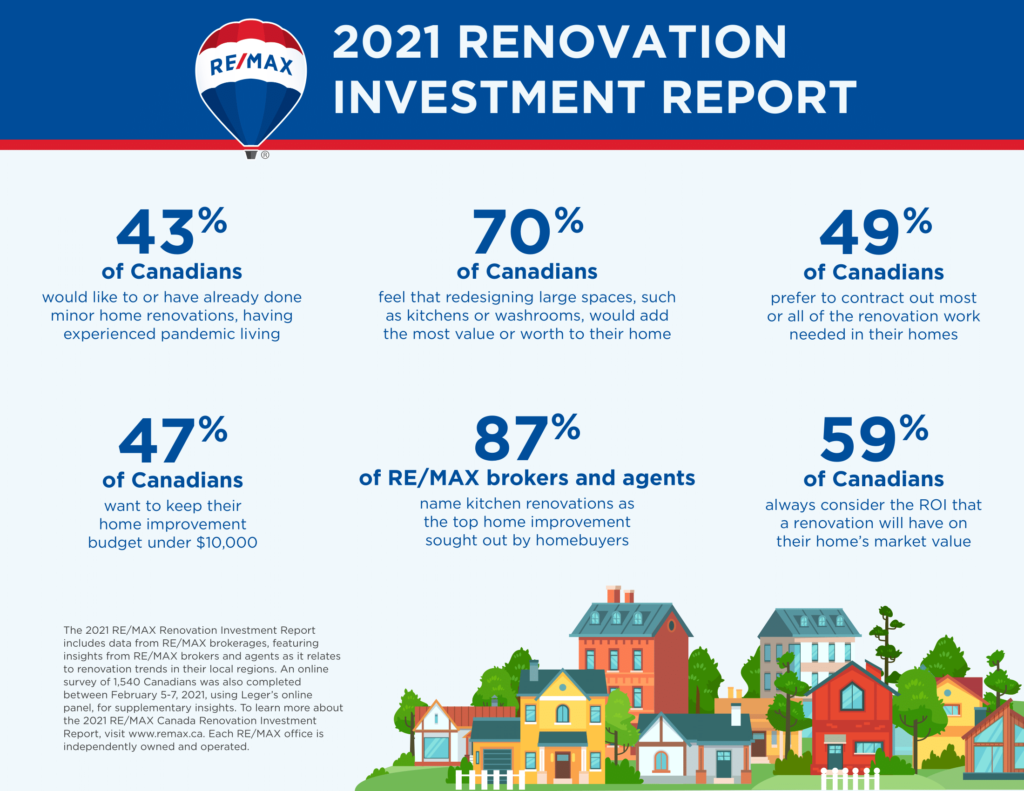
Canadians invest in home renovations to improve quality of life, not to add value in current Canadian real estate market

  • Challenging Canadian housing market conditions put additional importance to home renovations since the start of COVID-19, both for those looking to stay and those selling
  • More than half of Canadians renovated their home in 2020 with the intention of living in it, with 29% renovating to enhance their lifestyle for non-essential reasons (aesthetic and/or recreational purposes) and 29% doing so for essential reasons (safety and maintenance)
  • Only 16% of Canadians said they renovated to increase the market value of their home in order to sell within in the next one to three years

A new report by RE/MAX Canada is shedding light on shifting consumer trends in home renovations and the perceived return on investment (ROI), as impacted by COVID-19 and historically tight conditions across the Canadian real estate market. The RE/MAX 2021 Renovation Investment Report found that more than half of Canadians renovated their home last year for personal or “non-ROI” purposes, with three in 10 (29 per cent) choosing to renovate for non-essential “lifestyle” reasons, such as recreation-inspired projects.

A Leger survey conducted on behalf of RE/MAX Canada found lifestyle impact to be the top reason for renovating during the course of the pandemic, ahead of motives such as making essential renovations to accommodate life in lockdown (17 per cent), or to increase the value of the home with the intention of selling in the next one to three years (16 per cent).

Despite the trend of home renovations for personal use and enjoyment, 59 per cent of Canadians still said they always consider the return on investment that a renovation will have on their home’s overall market value, so while there is a current renovation trend based on lifestyle aspirations, practicality is never far from the surface.

“The notion of the home as an investment continues to be an important consideration for Canadian homeowners; however, they clearly value the home for what it is meant to be: a place to live and enjoy spending time,” says Elton Ash, Regional Executive Vice President, RE/MAX of Western Canada. “The pandemic has influenced virtually every aspect of our lives, including what Canadians want and need in a home. The uncertainty also compelled many sellers to move to the sidelines or renovate their home to accommodate current quality-of-life needs, which has further tightened conditions across many Canadian real estate markets.”

This lack of inventory is expected to be a continuing factor in the spring housing market across Canada. In its market outlook for 2021, RE/MAX identified seller’s market conditions in 82 per cent of regions, with a noted spike in demand for single-family dwellings putting additional pressure on already limited supply.

“Canadian real estate has continued to perform above and beyond expectations, with an increased opportunity for sellers to see a strong return on their investment given current demand,” says Christopher Alexander, Chief Strategy Officer and Executive Vice President, RE/MAX of Ontario-Atlantic Canada. “As we’ve seen over the past year, strong seller’s markets continue to dominate many regions across Canada, with homes selling in record time and at record prices. While the impact that specific renovations have on ROI will vary by regional conditions, the Canadian housing market has generally shown us that you can’t go wrong with anything that improves your home in any way.”

With this in mind, nearly one year after the start of cross-country lockdowns, Canadians are still making renovation decisions based on pandemic living, with over half (55 per cent) of survey respondents stating that they have already done or would like to do a home renovation within the next year. Of this group, 35 per cent say they would opt for minor renovations, such as painting.

RE/MAX brokers across Canada were also surveyed for the report and identified fresh paint and landscaping as two upgrades that yield a high ROI, despite being low-budget and minor in nature. This is in alignment with and good news for the nearly half (47 per cent) of Canadians who said they would want to keep their home improvement budget below $10,000, even if the guaranteed ROI was at least 10 per cent. Three in 10 Canadians (31 per cent) would bump up their spending from $10,000 to just under $50,000, and only four per cent would consider spending more than $50,000.

Sixty-five per cent of RE/MAX brokers surveyed also claim that kitchen upgrades, including cabinets, countertops and appliances, yield the highest ROI for sellers, with 87 per cent of brokers naming the kitchen renovation as the top home improvement resonating with buyers in the Canadian real estate market.

Renovations and Canadian Real Estate: Regional Market Insights
In Western Canada, Calgary, Edmonton and Victoria, homebuyers want the move-in-ready experience, with homes that are already entirely renovated being most in demand. Given this, sellers in these regions have the potential to see a large return on their renovation investment. In Greater Vancouver, outdoor improvements are one of the optimal ways for homeowners to get the best ROI, with landscaping among the top five renovations to undertake. It’s also one of the most common renovations that homeowners in this region are taking on themselves, versus hiring a professional to do the work.

Throughout Ontario, RE/MAX brokers are reporting that listings are selling quickly, regardless of their condition or renovation status. Regions including Toronto, Ottawa, Hamilton-Burlington, Niagara, London and Kingston/Napanee saw a strong shift toward outdoor upgrades and amenities in 2020, specifically the addition of a pool or larger exterior living area. Much of this demand was prompted by COVID-19 and the desire for more recreational space within the home – a trend that is not anticipated to be a permanent one. Bathroom renovations and new flooring are highly regarded as yielding the best return on investment. Across markets such as Mississauga, Thunder Bay, London, Barrie and Ottawa, painting is noted by RE/MAX brokers as the top renovation that homeowners are doing themselves, as well as one of the best ways to also see an improvement on ROI.

In Atlantic Canada provinces, RE/MAX brokers also placed importance on upgraded kitchens, but noted flooring upgrades as one of the best renovations for homeowners to get optimal ROI in regions including Fredericton, Saint John and St. John’s. Meanwhile in Charlottetown, roofing upgrades and landscaping are two of the top renovations that can be done relatively quickly to improve ROI, along with painting, as echoed across nearly all regions surveyed. In Saint John, the finished basement is one of the most sought-after renovations by buyers and creating more open-concept spaces is noted as one of the top three ways for sellers to get the best return on their investment.

Consumers’ Understanding of ROI
Only 51 per cent of Canadians claimed to have a thorough grasp of the renovation process and nearly half either don’t know or disagree that they have the understanding needed to make ROI-enhancing renovation decisions. Furthermore, 50 per cent of Canadians surveyed said they expect their REALTOR® to advise them on the right renovations to take on if they expressed interest in doing so when purchasing a home. This reliance on external professionals to guide home-buying decisions is anticipated to continue.

Additional highlights from the 2021 RE/MAX Renovation Investment Report

  • When it comes to the renovations that yield the best return on investment, Canadians see these as the best renovations to undertake:
    – 70% of Canadians state redesigning larger spaces, such as kitchens or washrooms
    – 56% of Canadians state minor updates, such as refreshing paint
    – 55% of Canadians state landscaping the outdoor space
    – 50% of Canadians state changing the home layout, including adding rooms or knocking down walls
    – 32% of Canadians state updating décor and furniture
  • 49% of Canadians prefer to contract out most or all of the renovation work
  • 33% of Canadians consider themselves to be very capable when it comes to home renovations, and don’t need professional help

About the 2021 RE/MAX Renovation Investment Report
The 2021 RE/MAX Renovation Investment Report includes data from RE/MAX brokerages. RE/MAX brokers and agents are surveyed on insights and local developments. Regional summaries with additional broker insights can be found at remax.ca.

About Leger
Leger is the largest Canadian-owned full-service market research firm. An online survey of 1,540 Canadians was completed between February 4-7, 2021, using Leger’s online panel. Leger’s online panel has approximately 400,000 members nationally and has a retention rate of 90 per cent. A probability sample of the same size would yield a margin of error of +/- 2.5 per cent, 19 times out of 20.

You live in the very best country in the world

Source

Canada tops ratings as “a stable and safe society in which individuals can develop and prosper, and is open, fair and equitable.”

Canada has been ranked the top country in the world according to a major new study.

For the first time, the U.S. News & World Report has placed the Great White North at the top of its annual Best Countries Report.

Canada spent several years in the second and third positions on the roundup. However, this year it ranked first in both the Quality of Life and Social Purpose sub-rankings, “meaning that it is seen as a stable and safe society in which individuals can develop and prosper, and is open, fair and equitable.”

The report – formed in partnership with BAV Group, a unit of global marketing communications company VMLY&R, and the Wharton School of the University of Pennsylvania – is based on a survey that asked more than 17,000 people from four regions to assess perceptions of 78 countries on 76 different metrics.

In addition to an overall ranking, the report includes 25 sub-rankings and “best for” lists including the Best Countries for Women, Most Powerful Countries and Best Countries for Racial Equality.

Three new countries – Cambodia, El Savador and Uzbekistan – are included in this year’s report.

Report authors mention that Canada adopted a national policy of multiculturalism in 1971, which celebrates diversity. Further, they mention that the North American country “welcomes immigrants” and has “participated in many peacekeeping missions.”

The report also notes that, with a national GDP of $1.74 trillion, Canada is a significant exporter of energy, food and minerals. “Canada ranks third in the world in proven oil reserves and is the world’s fourth-largest oil producer,” the report added.

Canada is also lauded as a “high-tech industrial society with a high standard of living.”

The top 10 countries in the world
1.Canada
2. Japan
3. Germany
4. Switzerland
5. Australia
6. United States
7. New Zealand
8. United Kingdom
9. Sweden
10. Netherlands

Single sheet of 4×8 plywood now costs more than $65

Source

Lumber prices have more than doubled in the past year and are still rising, adding another layer of cost to B.C.’s skyrocketing house prices

As of April 9, a basic SPF (spruce, pine, fir) two-by-four cost a record high of $1,132 per thousand board feet, according to the Ministry of Forests, Lands, Natural Resource Operations and Rural Development’s weekly B.C. lumber price tracking.

This compares to an average of $532 a year ago and to $372 in pre-pandemic 2019. The price was up nearly $100 from a week earlier.

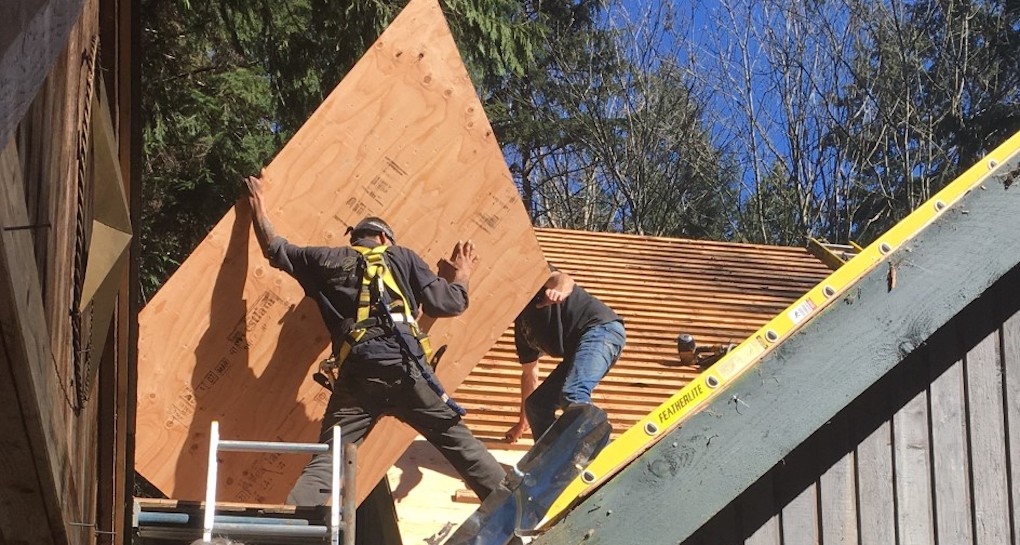
“A sheet of [4-foot by 8-foot] half-inch plywood costs $65 today. It was $51 a few days ago,” said contractor Brian Barker of Sunshine Coast Roofing Ltd. on April 12, as he prepped a roof for more than 50 sheets of plywood.

A standard eight-foot 2×4 is now more than $7 after tax, he added.

The price of standard plywood panels hit $1,223 per thousand board feet on April 9, up from $1076 a week earlier and twice the price from a year ago.

And there appears little relief in sight.

In a podcast hosted by Canadian Forest Industries, Keta Kosman, owner of Madison’s Lumber Reporter, said she is expecting the pace to continue for as much as the next couple of years – and not just because the pandemic sparked a boom in the repair and remodeling market. In 2020, millennials made up the largest cohort of first-time buyers for the first time, Kosman notes.

“So, we’re now having a large demographic entering the housing market that has nothing to do with the pandemic. So, it’s very positive [for lumber producers],” she said. “Definitely through this year, there will not be a slowdown, and potentially also through 2022.”

Lumber prices are now at all-time highs in both Canada and the US, and builders estimate the rising wood costs would nail an extra $10,000 to $20,000 onto the price of a new house.

“We do expect the lumber prices to stay quite elevated for quite a period of time,” said Kevin Lee, CEO of the Canadian Home Builders’ Association.

Simple upgrades that may increase the value of a home for sale

Source

A few DIY cosmetic upgrades can drastically alter the appearance of a home and help catch the attention of interested buyers, increasing your return when the home goes from ‘for sale’ to ‘sold.’

Looking to sell your home in the near future? Small investments in the aesthetic of the property could add value and increase the ROI – even if the renovations aren’t too costly.

With springtime underway, consider these DIY-friendly upgrades for a space refresh just in time to sell.

Paint the walls
Wall color preferences are personal, and statement choices like bold paint colors or accent walls can help people express their personal style within their home. Unfortunately, prospective buyers may not share that affinity for such boldness – and it may shape their view on the home in its entirety.

Consider repainting the interior walls a soft, neutral color. The coherence can help a home feel larger, and will present the space as a clean, blank canvas for an interested buyer to personalize.

Resurface kitchen cabinets
Often seen as the heart of the household, kitchens can be a make-or-break feature for prospective buyers. Unless they are planning on remodeling prior to move-in day, new homeowners will want a kitchen that is functional and at least moderately upgraded.

A quick and budget-friendly way to give your kitchen a makeover is to resurface the cabinets. Refacing them structurally and/or with a new coat of paint will update the overall appearance of the kitchen and can turn older or basic cabinetry into a more custom asset.

According to The Spruce, resurfacing cabinets can cost 40%-50% less than replacing kitchen cabinets altogether, making it a great option for sellers.

Shape-up outdoor space
From patios to grassy yards, outdoor space is an in-demand feature these days – especially heading into the warmer months. With grass growing green again and flowers beginning to bud, frame any outdoor living space on your property to look like a relaxing sanctuary.

Arrange existing patio furniture in an inviting way. Inexpensive outdoor additions include hanging Edison bulb string lights, planting flowers in pots and adding a weather-friendly rug under tables or chairs to frame the space. And remember, the greenery and landscaping in a backyard can make a home look more polished and sell for higher value – read up on why.

Stage with buyers in mind
In addition to thoroughly cleaning, refine any clutter or personal mementos inside the home. Simplifying the space will help it appear tidier and larger.

Working with the furniture and décor you already own is easy and free. As you assess what items line shelves, decorate the sofa and accent the bed, consider what you – the seller – would be thrown off by when touring someone else’s house. Also remember to highlight the space by opening up curtains and maximizing natural light when it’s time for showings.

Boost curb appeal
It doesn’t have to cost much money for the outside of a home to look welcoming and well-cared for. Make sure to mow the lawn and tend to any other greenery that may have overgrown or died in recent months. Adding items like a new welcome mat and planters beside the front door are low-cost ways to make a big impact on the home’s external appearance.

To give the exterior a more drastic makeover, consider repainting the front door for a pop of color. A pro tip is to paint the framing of the storm door outside as well for continuity.

Pro tips to design, maintain (and sell!) an outdoor oasis

Source

Warmer weather brings with it a feeling of new possibilities, and many homeowners ready for change needn’t look further than their own backyard. Literally.

Previously reserved as the dog’s domain, many homeowners are beginning to see the potential their yards offer to expand their functional living space (sorry, Fido).

“We’ve always enjoyed our outdoor spaces, but now people have taken it to a whole other level,” says Rose Kemp, a real estate agent with RE/MAX Town Centre in Orlando, Florida.

Kemp says many of her clients are adding amenities to their outdoor space that may have been closed during the pandemic, including putting greens, basketball courts, or even a “she shed” or “sports den.” Zen gardens and quiet areas for meditation are also becoming popular.

“People are creating additional space for whatever their lifestyle is,” Kemp says. “As families are spending more time at home, they’re realizing they aren’t limited to the space that’s inside the house and are creating more living and congregating areas.”

Homes are now being built to accommodate outdoor living. Newer models in Kemp’s Orlando market offer “garage style” doors that open dining areas up to an outdoor kitchen.

Similar to other updates homeowners might consider, adding amenities to a backyard could help increase a home’s value and become a selling point when it’s time to list. According to Kemp, a buyer may be willing to pay between $5,000-$10,000 more on a home with an updated yard than a comparable property without any functional outdoor space.

“Even if they have to pay a little bit more, buyers don’t want to have to recreate the landscaping because they would have to spend more cash out of their pocket,” she says.

In her area, that can mean adding a screen enclosure to a porch or a firepit for backyard barbecues. Of course, homeowners may want to think carefully before making what Kemp calls an “over improvement,” which is an expensive update that likely won’t recoup its cost during a sale. Pools, for example, don’t always offer a return on investment.

“Appraisers may be limited as to how much value they add to a home if it has a pool,” she says. “For example, even if you spend $80,000 installing a pool, it may add only $45,000 during an appraisal. That being said, if homeowners plan to stay in the home for few years, they should create the backyard that will make them the most happy!”

Outdoor space has become such an important consideration for buyers that some sellers are using photo editing software to show the possibilities of a listing that might not be in full bloom.

Peter Schravemade is the Strategic Relationship Manager for the virtual staging company BoxBrownie. He says that for some properties, showcasing the yard can be “essential to the sale.”

“We’ve seen landscaping edits happen more and more to demonstrate potential as buyers look for more space and, in particular, more functional space,” he says.

Real estate agents can also use the software to help buyers envision what a home will look like throughout the year – for example, removing snow from homes sold during winter or adding leaves to trees during the fall.

Schravemade says BoxBrownie can help potential buyers imagine ways they can make the backyard their own.

“My advice is for agents to keep it simple. The best case for this type of edit is to demonstrate an opportunity in the yard or remove an objection – for example, when the buyer says, ‘We would make an offer except for the state of the backyard,” Schravemade says.

Looking to create the perfect garden? Here’s the dirt.
Amenities are important, but lush landscaping is what really makes any outdoor escape come alive. Gardens can take years to reach their full potential, according to Colleen Sellers, owner of Planted Earth Landscaping in Denver, Colorado. Those looking to create a yard that will become a selling point should plant the seeds now.

Fortunately for those without a green thumb, a yard can be low maintenance and beautiful, according to Sellers. It just takes a bit of planning.

“There are no bad plants, just bad gardeners,” Sellers says. “It’s important to know what kind of sun access and soil you have, then pick plants that will thrive in that condition.”

She says to take note of the sun, water, and maintenance needs of plants before bringing them home. That’s one reasons succulents have seen a recent boom in popularity – they can add a modern look to most gardens while requiring very little water.

It may also be a good idea to read up on the latest trends – just like the fashion world, certain flowers and plants tend to fall in and out of style.

“Old-school juniper and dyed mulches aren’t popular right now, and hybrid tea roses can appear dated,” she says. “Knock out roses, which are easier to maintain and less susceptible to disease, are very much in style.”

Ornamental grasses, such as blue avena or shenandoah switch grass, are also on-trend thanks to their easy maintenance and pops of color. Sellers says clients are also more conscious of the environmental impact of their garden, choosing plants that require less water or attract pollinators to the area. For example, bees love hyssop or lavender.

“It’s also important to keep in mind that your design is growing, so it changes,” Sellers says. “It’s not like picking the right lamps which stay exactly the same. Plants will grow and do things that sometimes you’re surprised about!”

For those looking to take the guesswork out of gardening, there are plenty of benefits to hiring a professional. Not only can a pro landscaper advise which plants will thrive in a certain yard’s conditions, they can also save homeowners the time and labor of installation.

“I think a lot of homeowners start a project and get about a fourth of the way in and realize how difficult it is to relocate 10 wheelbarrows of soil,” Sellers says. “When you a hire a professional, we save you the sweat equity of doing everything yourself.”

Creating an outdoor space can take a lot of work and be an investment. But according to Kemp, it not only opens up room for entertaining and hobbies, it can provide a way for the current owner’s story to live on after the home is sold.

“I have friends from Puerto Rico who chose amazing plants that reminded them of home and staged their yard perfectly, so you feel like you are on a tropical island in their backyard,” Kemp says. “They put so much work into it, and that will be attractive to a buyer. They’ll see a whole creation that is already done – buyers love that.”

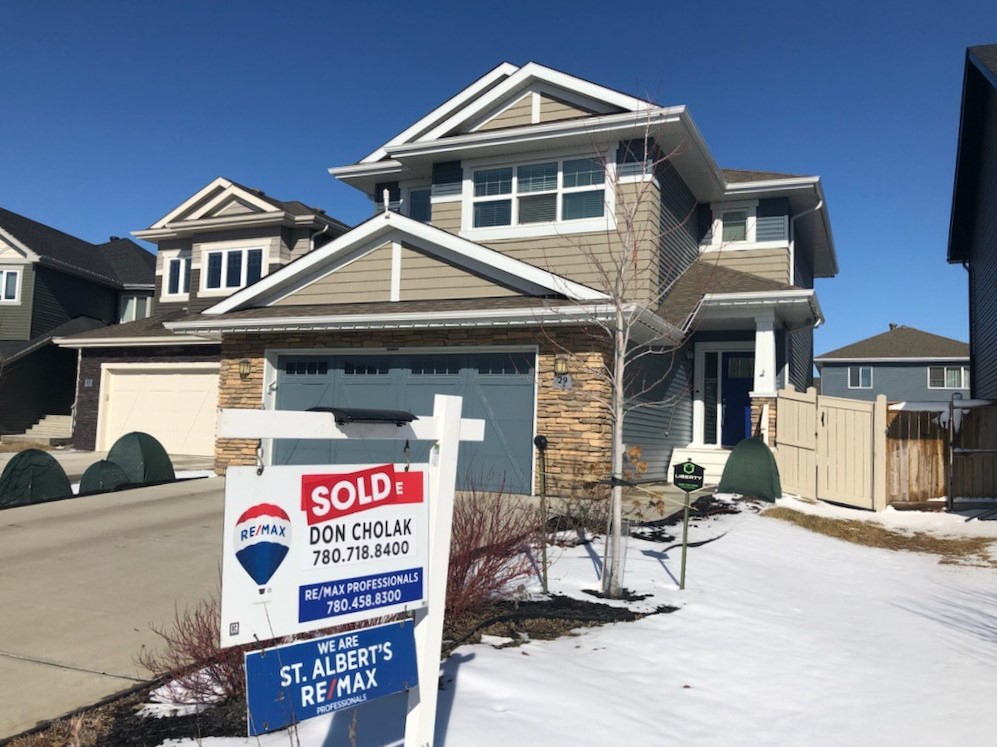
SOLD! : 29 Elise Place : St. Albert

Don Cholak just SOLD this 4 bedroom, 4 bathroom single family home in the Erin Ridge North area of St. Albert!


SOLD for LIST PRICE! Don would like to thank his clients for trusting him to get their home SOLD!
 
 
Are you ready to put Don Cholak’s decades of experience to work for you? Get started by clicking the appropriate button below! Or, call Don at 780-718-8400 or email Don@DonCholak.com now!

Sellers start here button

Buyers start here button

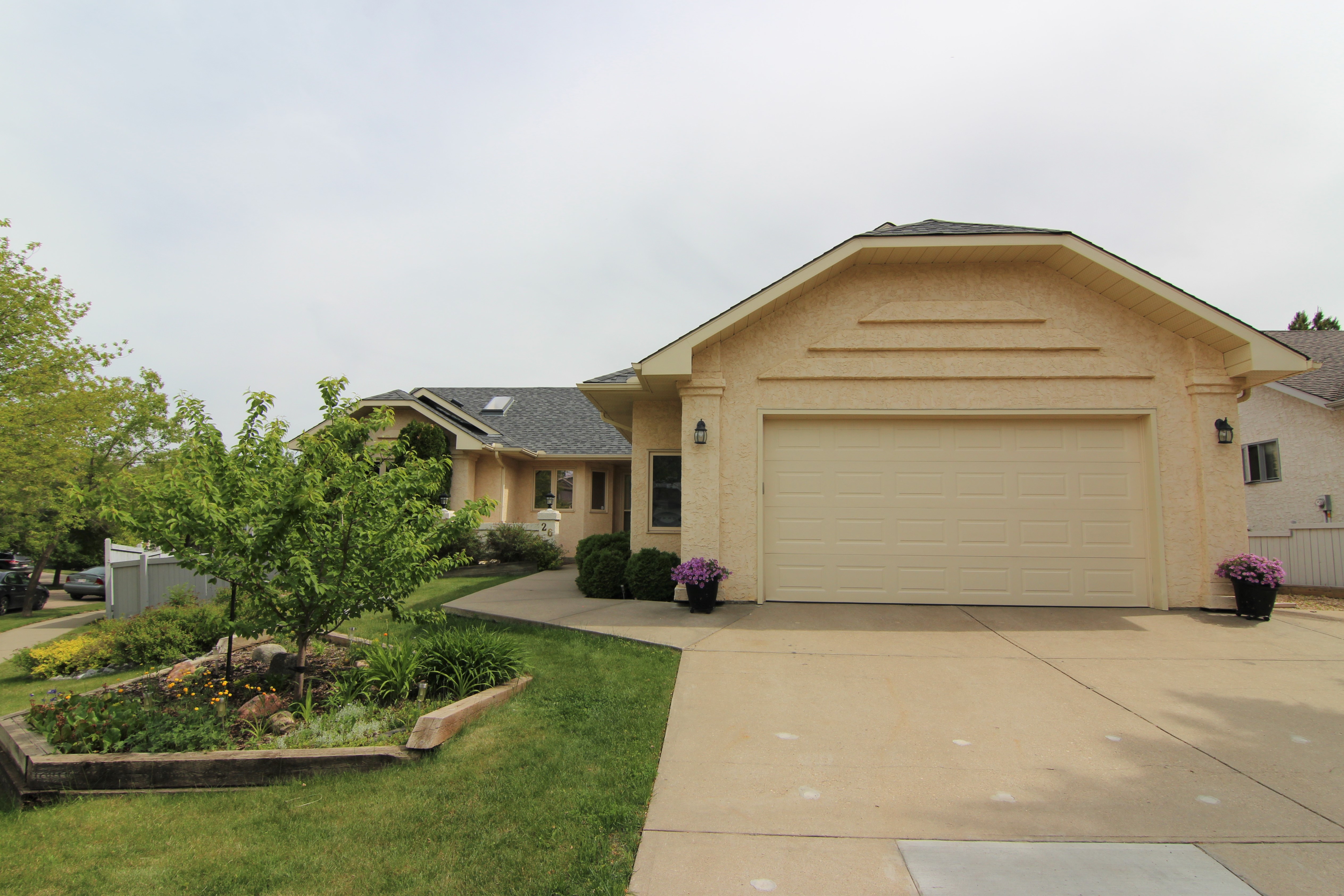
26 Orion Close : St. Albert : E4237102

Welcome to this 4 bedroom, 3 bathroom, 1739sq.ft singly family home in Oakmont!


MLS#: E4237102 NEED MORE SPACE for work and school at home? This Summit custom-built bungalow has all the S P A C E you could need! Featuring a main-floor HOME OFFICE with custom built-in wall-to-wall desk with enough room for three work stations! Plus there’s three bedrooms on the main floor and one more in the basement! No need to leave the house for the spa anymore – escape to your very own master retreat to relax in the JETTED TUB! In addition to the formal living room with gas fireplace and large eat-in kitchen on the main floor, there are two living spaces downstairs, with ample room for a TV area, a pool table, and even a HOME GYM! Kick back and enjoy the sun on the large southeast-facing back deck, and spend evenings gathered around the fire pit with the family! Additional features of this remarkable home are central AIR CONDITIONING, main floor laundry, NEWER SHINGLES, landscaped yard with underground sprinkler system, OVERSIZED DOUBLE GARAGE measuring 25×24 feet, RV PARKING – all located on a large CORNER LOT!
 
Listing-Details-Button

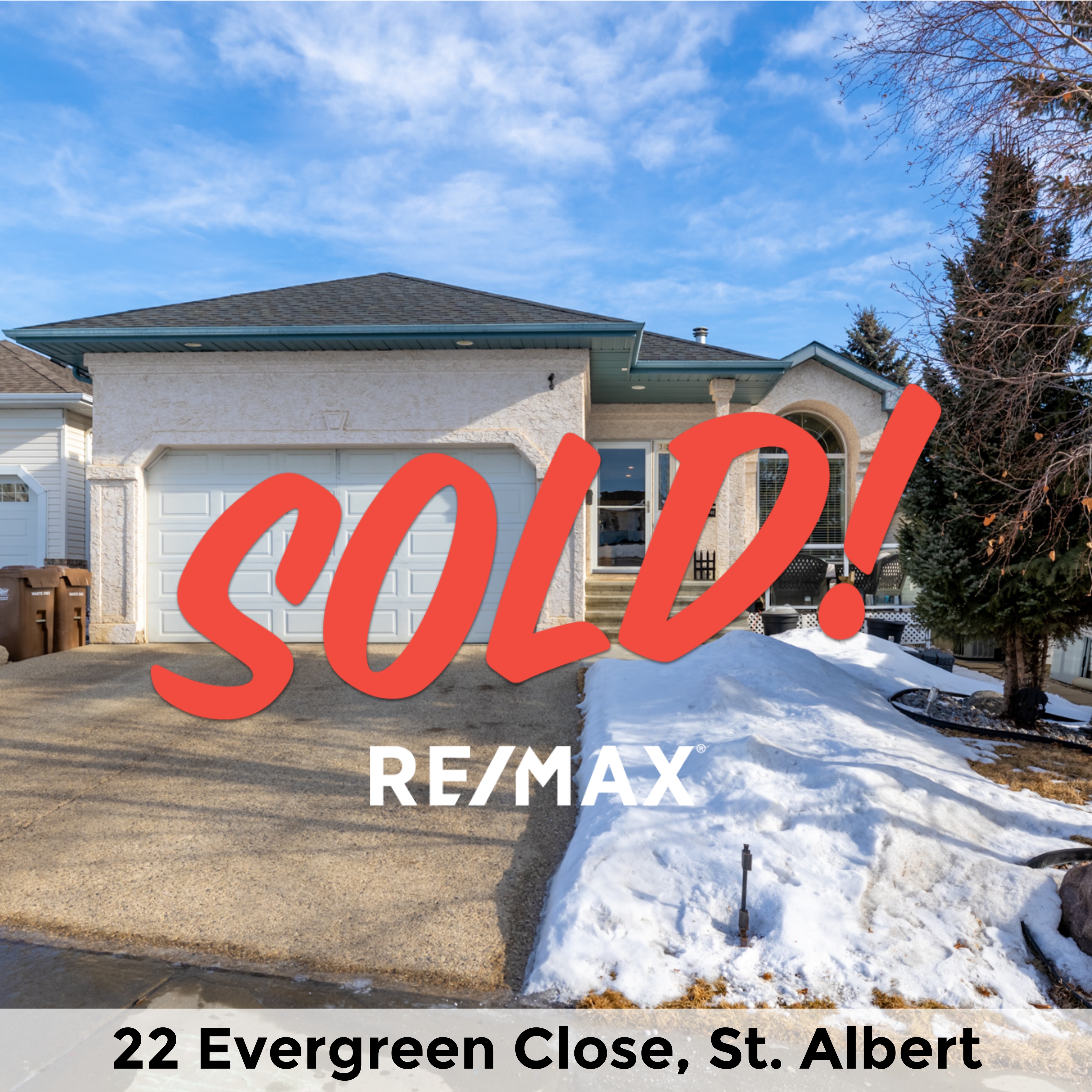
SOLD! : 22 Evergreen Close : St. Albert

Don Cholak just SOLD this 5 bedroom, 3 bathroom single family home in the Erin Ridge area of St. Albert!


SOLD in 3 weeks for 98% of list price!
 
 
Are you ready to put Don Cholak’s decades of experience to work for you? Get started by clicking the appropriate button below! Or, call Don at 780-718-8400 or email Don@DonCholak.com now!

Sellers start here button

Buyers start here button